Our mission
SPARK was first intended to be a website where people who love space could join together and read about big questions and theories that cost many people — including me and my dad — sleepless nights and long hours of reading and research. Here we'll also keep simulations and live rocket sounds, high quality audio of real rockets and spacecraft in space.
While building this website, my dad and I are working separately on a real research project — one we plan to send to NASA. Even if NASA doesn't accept it, we'll keep building it and see it through anyway. So by the end of my high school years, we want two things to exist: my first real research project, and a physical device we built with our own hands.
My first research goal is about Jupiter — it's my favorite planet.
— Saanvi, founder
Researches
Everything SPARK is actively researching, in one place:
Wormholes & time travel
Can a traversable wormhole exist? What does real physics say about traveling to the past or future? Our own wormhole settlement concept, Threshold Station.
Aliens, SETI & exoplanets
Is there life elsewhere, how would we recognize it, and could intelligent civilizations ever communicate across the distances involved?
Jupiter — our first research project
Saanvi's first real research goal, and the planet SPARK is starting with, before it becomes a physical device.
Research: Wormholes & time travel
Can a traversable wormhole exist?
Einstein's own equations allow for wormholes — tunnels connecting two far-apart points in space. The catch: every known solution needs "exotic matter" with negative energy, which nobody has ever observed. Physicist Kip Thorne worked out the real math behind the wormhole in the movie Interstellar — so the movie's wormhole isn't pure fantasy, it's a real (if unproven) idea.
Time travel — the part that's already real
Traveling to the future is proven physics: near massive objects or at near-light speeds, time runs slower. GPS satellites correct for this every day. Traveling to the past is the open question — Stephen Hawking suspected the universe has a built-in rule against it ("chronology protection"), joking that the best evidence is that we're not swarmed with visitors from the future.
Our own wormhole concept: Threshold Station
A free-space settlement stationed near a theoretical stabilized wormhole in the outer solar system — half permanent home, half deep-space listening post aimed at a real candidate "superhabitable" planet (KOI 5715.01, found by NASA's Kepler telescope).
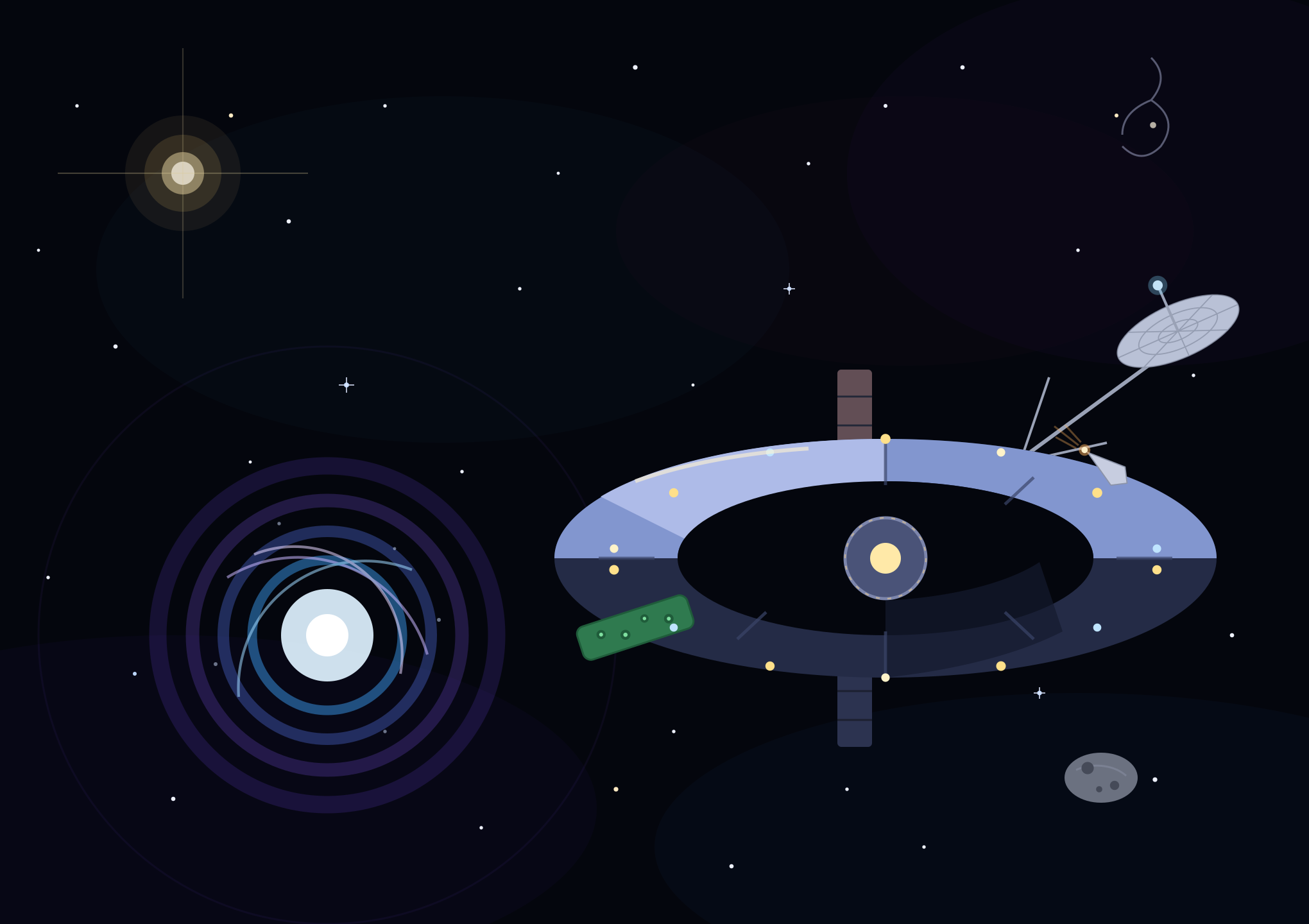
— researched by Saanvi
Simulators: What ifs
Space is full of situations you'd never survive in real life — so we ask the questions here instead.
What if you fell outside the space station without a suit?
You wouldn't explode. You'd have about 10–15 seconds of consciousness as oxygen leaves your blood, and the saliva on your tongue would boil — not from heat, but because liquids can't stay liquid in a vacuum. If crewmates pulled you back inside within about a minute, you'd likely survive. It happened for real in a 1966 NASA lab accident.
What if you lit a torch in space?
It works fine — no air needed for an LED or a battery. But with nothing nearby to light up, your photo comes out pure black. The light itself never stops, though: it travels forever until it hits something, or nothing at all.
What if you struck a match in space?
The match head has its own built-in oxidizer, so it flashes and burns out in a second — but the wooden stick, which needs real air, never catches. A tiny solid-rocket-motor moment, not a campfire.
More what-ifs coming soon — got one? Ask us.
Sounds: live radio voices of space
Space is silent — sound can't travel through nothing. But space is full of radio waves and magnetic ripples that become sound with the right ears. Our favorites:
Hear meteors fall, live · A comet that sings (Rosetta, 2014) · Black holes turned into sound
Dad also wrote a program that turns live solar wind data — from a real spacecraft 1.5 million km away — into music. Ask us about it.
Research: Aliens, SETI & exoplanets
Is there life elsewhere?
Nobody knows — but the odds look interesting. Roughly 1 in 5 Sun-like stars may host an Earth-sized planet in its habitable zone. Across the galaxy, that's billions of candidates. Scientists use the Drake equation to estimate how many communicating civilizations might exist — its honest answer today ranges from "we're alone" to "millions."
How would we recognize it?
Two ways: reading a distant planet's atmosphere for gases like oxygen that shouldn't be there without life, or listening for an artificial radio signal — narrow, patterned, unlike anything nature makes. That's SETI (Search for Extraterrestrial Intelligence), running since 1960. In 1977 a telescope caught the famous "Wow! signal" — 72 seconds, strong, never repeated, still unexplained.
Could intelligent civilizations communicate?
Radio waves already can — they travel at light speed, the universe's speed limit, no spaceship required. The catch is patience: a signal to a star 100 light-years away takes 100 years to arrive and 100 more for a reply. Listening is still the fastest, cheapest way to search.
Interesting facts about our planets
Jupiter blasts out radio storms powerful enough for backyard antennas to hear, driven by its moon Io moving through Jupiter's magnetic field.
More planet facts coming as we research each one — ask us which planet to cover next!
Ask us anything about space
Got a space question? Send it in — Saanvi reads every one and answers, usually within a week or two.
Email us your question →murtisaanvi@gmail.com
About us
SPARK Communications is a space program founded by Saanvi — grade 8, future alien-hunter. Teaching myself space science and coding, and everything I decode, I explain here in plain words, so anyone can understand it.
Our mission is in our name: Space Program for Alien Research & Knowledge. One day I'll build a device and listen for a signal from another civilization. This website is step one.
The universe has been broadcasting for 13.8 billion years. SPARK is here to finally listen.
Founder: Saanvi Murti
Mission log
July 2026 — SPARK Communications is founded. We bought SPARKcom.net, learned meteors, comets and asteroids, and built the Solar Wind Radio. Mission begins.
August 2026 — Saanvi designed SPARK's full content plan and site structure by hand, and Threshold Station (our wormhole settlement concept) took shape.
Coming up — Perseid meteor shower: watch the sky and listen to it. This fall: building a backyard radio telescope to hear Jupiter.